
BASEMENT WATERPROOFING · REYNOLDSBURG, OH
Basement Waterproofing Cost in Reynoldsburg, OH
Here are real numbers. This is exactly why we publish them — you should be able to work out roughly what your job costs before you talk to anyone. These are the ranges we quote in Reynoldsburg and the east Columbus area, not national averages. Every job still gets an on-site inspection and a written fixed price, because the same symptom here has several causes and they do not cost the same. Call (614) 739-0757 and we will tell you which range applies to your basement.
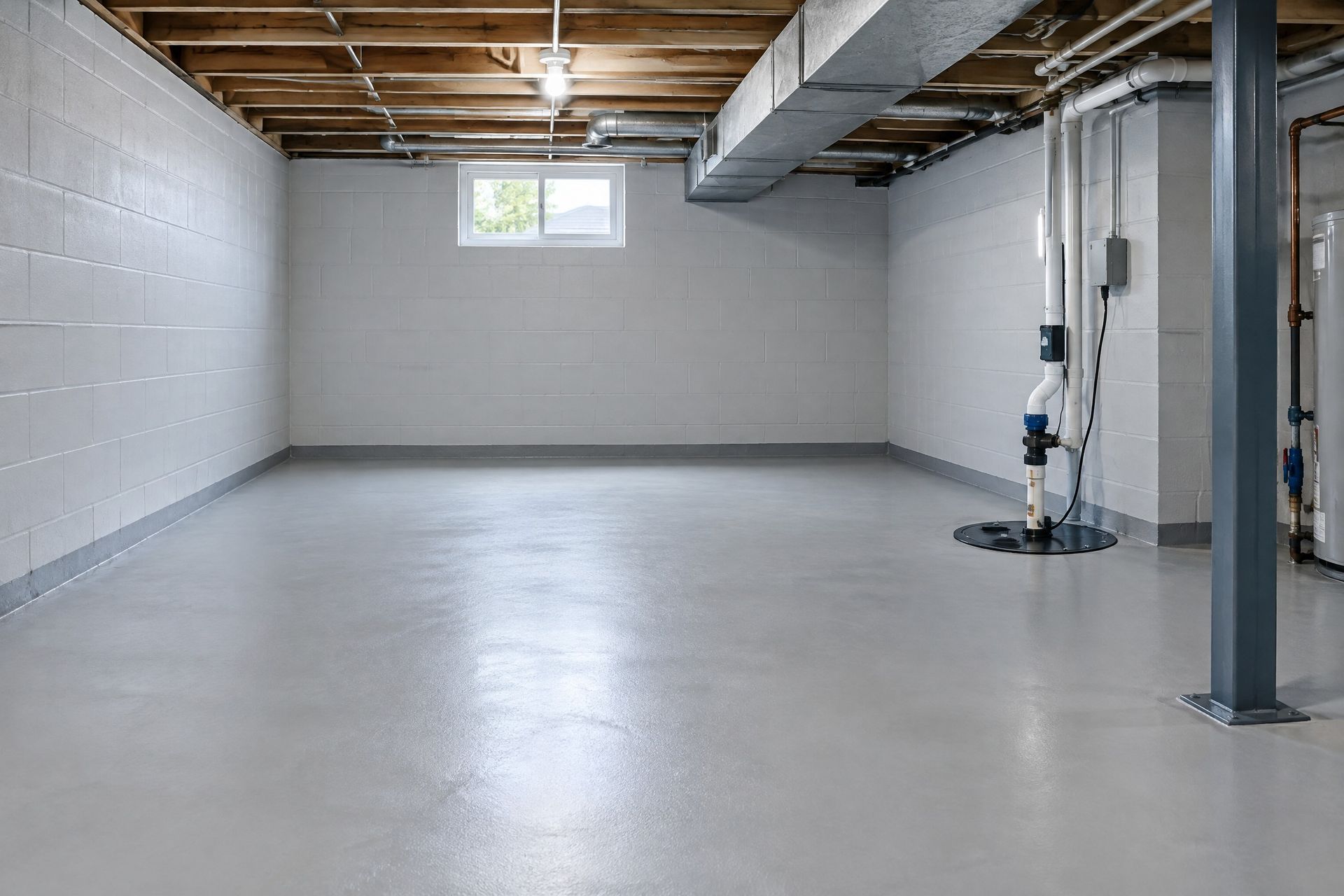
What basement waterproofing costs in Reynoldsburg
Ranges reflect Reynoldsburg and east Columbus jobs. Where your project lands depends on footage, foundation type and access.
| Service | Typical Zanesville range |
|---|---|
| Sump pump replacement only | $650 – $1,400 |
| Battery backup added to an existing sump | $700 – $1,500 |
| Foundation crack injection, one wall | $900 – $2,200 |
| Exterior drainage correction and grading | $1,400 – $4,500 |
| Interior drain tile, one wall | $3,200 – $6,500 |
| Interior drain tile, full perimeter | $7,500 – $15,000 |
| Crawl space encapsulation | $4,500 – $12,000 |
| Carbon fiber straps for a bowing block wall | $500 – $900 per strap |
| Steel I-beam bracing | $900 – $1,600 per beam |
| Exterior excavation and membrane, one elevation | $9,000 – $18,000 |
| Exterior excavation and membrane, full perimeter | $20,000 – $38,000 |
New Paragraph
What drives the number on your quote
Six factors account for nearly all the variation between the low and high end of every range above.
- Linear or square footage — one wall versus a full perimeter is the single biggest swing
- Foundation type, since expansive clay movement affects poured concrete and block walls differently
- Depth to the footing, which drives every exterior price directly
- Access — equipment reach outside, headroom inside, and whether a finished basement has to be opened
- Obstructions over the work line: decks, patios, driveways, mature trees, furnaces and water heaters
- Restoration scope, including landscaping, hardscape and flooring that has to be replaced
Get Your Free Quote
Why we publish prices
The standard practice in this industry is to keep numbers off the website so that price is only revealed at the end of an in-home sales visit, after ninety minutes of relationship building and a presentation. That approach exists because it works — on the salesperson's side. It leaves the homeowner unable to tell whether a quote is reasonable without booking three more appointments, and it makes same-day discount pressure possible, because you have no reference point to compare against.
We would rather you arrive at the conversation already knowing roughly what the work costs. If our range is wrong for your house we will explain why standing at the wall, with a written fixed price you can take away and sit on. There is no expiring discount, because a price that evaporates at the end of a visit was never a real price. The practical benefit is that the people who call have already decided the numbers are workable, which makes for a much better conversation than a cold pitch.
What is included in every quote
These are in the price rather than added later.
- The permit, where required by the local authority, should be confirmed before work begins
- All materials, including pump, battery backup, sealed lid, gravel, filter fabric and liner
- Protection and cleanup — floors covered, contents moved, dust containment, debris hauled away
- Concrete patching on interior work, and grading restoration on exterior work
- Written workmanship details and the manufacturer warranty on every pump and dehumidifier
- A walkthrough showing you the system and how to test it yourself twice a year
Why a much cheaper quote is usually a different job
If a quote for interior drainage comes in far below the ranges above, the most likely explanation is that it is not the same work. The common substitution is a plastic channel adhered to the top of the existing slab at the wall-floor joint, sold as a drainage system. No concrete is cut, nothing is installed below floor level, and it catches water only after it has already come up through or across the floor. In Reynoldsburg, with dense till and expansive clay holding water against the foundation, that does not manage the mechanism. The tell is simple: ask whether the floor will be cut. If the answer is no, there is no tile below it.
The other pattern is a quote that omits the parts nobody sees. A sump basin with an open or loose-fitting lid rather than a bolted and grommeted one, which lets humidity and radon back into the basement. No battery backup, in a market where the storms that send fast runoff toward Blacklick Creek are the same storms that cut power. Gravel replaced with native clay backfill around the tile, which silts the pipe within a decade. None of it is visible at handover, and all of it decides whether the system works in five years. We are happy to be compared line by line — just make sure the lines are the same.
If you cannot do all of it right now
Plenty of Reynoldsburg basements need more than the homeowner can spend this year, and pretending otherwise does nobody any good. The work has a natural order. Anything structural comes first, because a wall that is moving gets worse and costs more later. Then whatever is putting water against the foundation from outside — grading and downspout extensions are genuinely cheap and sometimes cut the problem in half on their own. Then drainage. Then encapsulation and comfort items. Doing them in that sequence means each stage still makes sense when you get to the next one.
We will quote a phased plan in writing so you can see what each stage costs and what it achieves, and we will hold the pricing on later phases for a reasonable period rather than requoting from scratch. We would rather do the urgent third of the job properly this spring and see you again next year than sell you a financed package that stretches you. If the honest answer is that a two hundred dollar downspout extension and a regrade solves your problem, that is what we will tell you, and it happens more often than you would expect.
How our quotes work
The inspection is free and takes about forty-five minutes. We look at the walls inside and the grade outside, identify the foundation type, check for deflection caused by clay expansion, and trace where the water is actually coming from. Then you get a written fixed price — a real number for a defined scope, not a range and not an estimate that moves once work starts. If we open something up and find a condition nobody could have seen, we stop and talk to you before doing anything that changes the price. There is no obligation, no expiring discount, and no follow-up pressure. Take the quote, compare it, and call us if the numbers make sense.
GOOD TO KNOW
FAQs
What does basement waterproofing cost in Reynoldsburg, Ohio?
Most Reynoldsburg jobs fall between $3,200 and $15,000. Interior drain tile on one wall typically runs $3,200 to $6,500, and a full perimeter $7,500 to $15,000. Foundation crack injection runs $900 to $2,200 per wall, and exterior drainage correction $1,400 to $4,500. Crawl space encapsulation is $4,500 to $12,000. Exterior excavation is the expensive end at $9,000 to $18,000 for one elevation and $20,000 to $38,000 for a full perimeter. At the small end, a sump pump replacement alone is $650 to $1,400.
Why is exterior waterproofing so much more expensive?
Because you are moving earth rather than cutting concrete. The trench has to reach the footing, which in Reynoldsburg is typically seven to eight feet down, and every cubic yard of dense till that comes out has to be staged somewhere and put back. Add equipment, utility locates, membrane materials, granular backfill to replace the clay, and restoring whatever was growing or paved over the dig line. It is genuinely more work, which is also why it should only be quoted when the diagnosis calls for it.
Does homeowners insurance cover this?
Generally not. Standard policies exclude damage from groundwater seepage and surface water entering below grade, which is precisely what waterproofing addresses. Some policies cover a sudden sump pump failure or a discharge backup if you carry a specific endorsement, and that is worth checking. Flood damage requires separate flood insurance entirely. What we can help with is documentation — photographs and a written description of conditions — if you decide to file.
Do you offer financing?
It protects value more than it adds it, which is a reWe will quote the work in phases so it can be spread across budget years, with pricing held on later stages for a reasonable period. We would rather stage the work in the right order — structural first, then exterior water sources, then drainage, then comfort — than push you into a financed package for the whole thing at once. If a two hundred dollar downspout fix addresses most of your problem, we will say so.al distinction. A dry basement with documented work and a written warranty removes an objection at sale; a wet one produces a buyer credit request that is nearly always larger than the actual cost of fixing it. Keep the paperwork and the warranty — being able to hand a buyer a permit number and a warranty is worth more than saying it was done.
Is the free inspection really free?
Yes, with no obligation and no conditions. You get a written fixed-price quote you can keep, compare and act on whenever you like. We do not do same-day pressure discounts, because a price that expires at the end of a sales visit was never a real price. If we conclude you do not need the work, we will tell you that too — and that outcome is more common than you might think.
Find out which number applies to your basement
Free on-site inspection, about forty-five minutes, and a written fixed price you can take away and compare. No obligation and no expiring discount.